

40+ Bible Verses About Discrimination (With Meaning & Commentary)

Discrimination — treating people as less valuable based on race, background, gender, wealth, or appearance — is not a new problem. It has existed in every human society, and it existed in the world in which the Bible was written. What makes Scripture remarkable is how directly it addresses it.
This collection covers the most important Bible verses about discrimination, organized by theme so you can find what you need quickly — whether you’re studying, preparing a message, looking for personal encouragement, or simply trying to understand what God’s Word actually teaches on the subject.
— Note: This guide uses the World English Bible (WEB) translation, which renders God’s personal name as “Yahweh” (equivalent to “the LORD” in other versions like KJV or NIV). All verse quotes reflect this translation unless otherwise noted. —
What Does the Bible Say About Discrimination?
The Bible opposes discrimination consistently, across both testaments, and at every level from personal conduct to community justice. The biblical teaching is rooted in two foundational convictions: God himself does not show favoritism, and every human being is made in his image.
“God created man in his own image. In God’s image he created him; male and female he created them.” — Genesis 1:27, WEB
This is the starting point for everything the Bible teaches about human equality. If every person — regardless of ethnicity, gender, or social standing — bears the image of God, then treating any person as inferior is an offense against their Creator.
“For there is no distinction between Jew and Greek; for the same Lord is Lord of all, and is rich to all who call on him.” — Romans 10:12, WEB
Paul’s statement to the Romans cuts across the sharpest ethnic boundary of his day. The same principle extends to every division humans create — national, cultural, racial, or social.
God Shows No Favoritism
One of the clearest anti-discrimination statements in all of Scripture is not a command to humans — it is a description of God’s own character.
“For God doesn’t show favoritism.” — Romans 2:11, WEB
“Peter opened his mouth and said, ‘Truly I perceive that God doesn’t show favoritism.'” — Acts 10:34, WEB
This declaration came after Peter’s vision that broke down the Jewish food laws — laws that functioned as a social barrier between Jews and Gentiles. His conclusion was theological: if God accepts people from every background equally, then so must his people.
“He made no distinction between us and them, cleansing their hearts by faith.” — Acts 15:9, WEB
The ‘us and them’ Peter refers to are Jews and Gentiles — two groups with centuries of mutual suspicion. God’s response to both was identical. Faith, not ethnicity, was the only qualifier.
“But God has shown me that I shouldn’t call any man unholy or unclean.” — Acts 10:28, WEB
Peter spoke this to Cornelius, a Roman Gentile. No person’s background makes them spiritually inferior or socially untouchable.
Old Testament Verses on Partiality and Justice

The Hebrew Bible established an ethic of impartial justice long before the New Testament. The law of Moses directly commanded Israel’s courts to judge without favoritism — and the prophets held the nation accountable when they failed.
“You shall not curse the deaf, nor put a stumbling block before the blind; but you shall fear your God. I am Yahweh.” — Leviticus 19:14, WEB
Exploiting someone who cannot defend themselves — whether through disability, poverty, or vulnerability — is condemned as a failure to fear God.
“These also are sayings of the wise: To show partiality in judgment is not good.” — Proverbs 24:23, WEB
“To show partiality is not good; yet a man will do wrong for a piece of bread.” — Proverbs 28:21, WEB
Favoritism often has a price, and the Bible says it is never worth paying.
“You shall not show partiality in judgment; you shall hear the small and the great alike. You shall not be afraid of the face of man, for the judgment is God’s.” — Deuteronomy 1:17, WEB
Moses’s instruction to Israel’s judges was clear: justice must not vary based on a person’s status, wealth, or influence. The phrase ‘you shall not be afraid of the face of man’ speaks directly to the social pressure that makes partiality so tempting.
“There are six things which Yahweh hates; yes, seven which are an abomination to him: arrogant eyes, a lying tongue, hands that shed innocent blood, a heart that devises wicked schemes, feet that are swift in running to mischief, a false witness who utters lies, and he who sows discord among brothers.” — Proverbs 6:16–19, WEB
Among the things God hates, sowing discord — deliberately stirring division between people — appears on the list. Discrimination that breeds hostility and fractures the community is not a minor matter.
“Do not judge by appearance, but judge righteous judgment.” — John 7:24, WEB
Jesus issued this warning during a confrontation over the law. Judging people by how they look, what they wear, or where they come from, rather than by the content of their character, directly contradicts this command.
New Testament Verses Against Discrimination
In Christ, Social Divisions Lose Their Power
“For as many of you as were baptized into Christ have put on Christ. There is neither Jew nor Greek, there is neither slave nor free man, there is neither male nor female; for you are all one in Christ Jesus. If you are Christ’s, then you are Abraham’s offspring and heirs according to promise.” — Galatians 3:27–29, WEB
Paul dismantles three of the most rigid social divisions of the first century — ethnicity, class, and gender — and declares all three irrelevant before God. Theologians have called this the Magna Carta of Christian equality.
“There is neither Greek nor Jew, circumcision nor uncircumcision, barbarian, Scythian, bondservant, nor free; but Christ is all, and in all.” — Colossians 3:11, WEB
‘Barbarian’ and ‘Scythian’ were terms the Romans used to refer to people they considered uncivilized. Paul places them on equal footing with everyone else. No cultural category survives the cross.
“For he is our peace, who made both one, and broke down the middle wall of separation.” — Ephesians 2:14, WEB
The ‘middle wall’ refers to the barrier in the Jerusalem Temple separating Jews from Gentiles. Paul uses it as a symbol of every wall discrimination builds — and declares that Christ has demolished it.
The Golden Rule and Its Reach
“Therefore whatever you desire for men to do to you, you shall also do to them; for this is the law and the prophets.” — Matthew 7:12, WEB
“The second is like this: ‘You shall love your neighbor as yourself.’ There is no other commandment greater than these.” — Mark 12:31, WEB
“For the whole law is fulfilled in one word, in this: ‘You shall love your neighbor as yourself.'” — Galatians 5:14, WEB
Three passages, one consistent principle: neighbor-love is the summary of the entire moral law. Any form of discrimination directly contradicts this command.
The Book of James: The Clearest Warning Against Favoritism
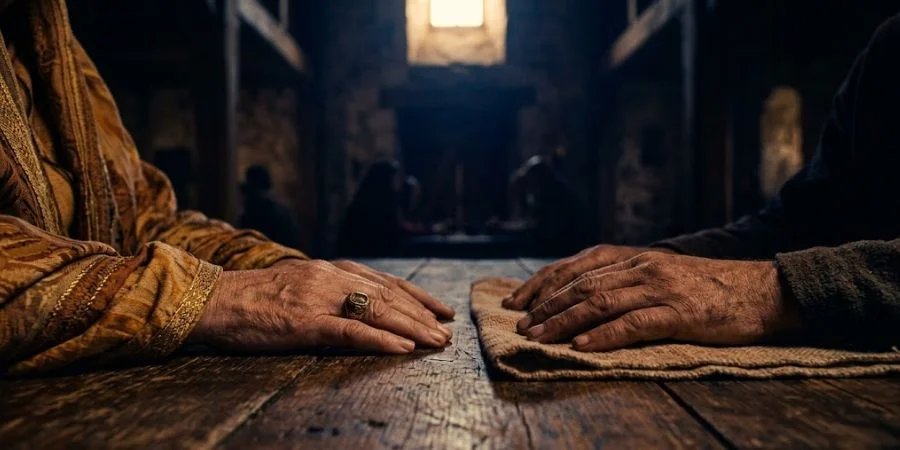
If any part of the New Testament reads like a direct policy statement against discrimination, it is James chapter 2. The writing is blunt, practical, and impossible to soften.
“My brothers, don’t hold the faith of our Lord Jesus Christ of glory with partiality.” — James 2:1, WEB
“For if a man with a gold ring, in fine clothing, comes into your synagogue, and a poor man in filthy clothing also comes in; and you show regard to him who wears the fine clothing, and say, ‘Sit here in a good place;’ and you tell the poor man, ‘Stand there,’ or ‘Sit by my footstool;’ haven’t you shown partiality among yourselves, and become judges with evil thoughts?” — James 2:2–4, WEB
James gives a scene so specific it reads like a real incident. Two people walk into the same gathering. One is wealthy, one is poor. The wealthy person is given the best seat; the poor person is told to stand or sit on the floor.
James calls this ‘evil thoughts’ in action. The scenario is ancient, but the dynamic — differential treatment based on visible markers of status is recognizable in every era.
Racial Discrimination and Scripture
The Bible does not use the modern category of race, but it addresses ethnic and national prejudice directly — and often in ways that were socially disruptive in their original context.
“Miriam and Aaron spoke against Moses because of the Cushite woman he had married.” — Numbers 12:1, WEB
This is one of the earliest recorded instances of ethnically motivated criticism in Scripture. Moses’s sister and brother objected to his wife’s Cushite (African) background. God’s response was to rebuke Miriam — a direct judgment against ethnic prejudice.
“After these things I looked, and behold, a great multitude which no man could count, out of every nation and of all tribes, peoples, and languages, standing before the throne and before the Lamb.” — Revelation 7:9, WEB
The final picture of God’s redeemed community is deliberately multiethnic. Every nation, every tribe, every language — present and equal before the throne.
“They sang a new song, saying, ‘You are worthy to take the book, and to open its seals: for you were killed, and bought us for God with your blood, out of every tribe, language, people, and nation.'” — Revelation 5:9, WEB
“The Spirit and the bride say, ‘Come!’ He who hears, let him say, ‘Come!’ He who is thirsty, let him come. He who desires, let him take the water of life freely.” — Revelation 22:17, WEB
The invitation at the very end of Scripture is unrestricted — ‘whoever desires.’ No ethnic qualifier, no class filter, no national requirement.
“I have other sheep which are not of this fold. I must bring them also, and they will hear my voice. They will become one flock with one shepherd.” — John 10:16, WEB
Jesus spoke of a flock that would include people from beyond Israel’s borders — a clear signal that God’s welcome was never meant to be ethnically exclusive.
📩 Want to receive new Bible verse daily?
 Join our WhatsApp Channel
Discrimination Against the Poor

“I solemnly charge you in the sight of God, and the Lord Jesus Christ, and the chosen angels, that you observe these things without prejudice, doing nothing by partiality.” — 1 Timothy 5:21, WEB
Paul’s charge to Timothy places the prohibition on partiality before God and angels as witnesses — a solemn weight that underscores how seriously God takes economic discrimination.
“Now in those days, when the number of the disciples was multiplying, a complaint arose from the Hellenists against the Hebrews, because their widows were neglected in the daily service. The twelve summoned the multitude of the disciples and said, ‘It is not appropriate for us to forsake the word of God and serve tables. Therefore select from among you, brothers, seven men of good report, full of the Holy Spirit and of wisdom, whom we may appoint over this duty.'” — Acts 6:1–3, WEB
Even in the earliest church, economic discrimination surfaced. The Hellenist widows were being overlooked in daily food distribution. The apostles’ response was immediate and structural — they appointed dedicated leaders to ensure equal care. Discrimination was not tolerated; it was corrected.
“But Yahweh said to Samuel, ‘Don’t look on his face, or on the height of his stature, because I have rejected him; for I don’t see as man sees. For man looks at the outward appearance, but Yahweh looks at the heart.'” — 1 Samuel 16:7, WEB
God’s word to Samuel cuts to the core of every appearance-based prejudice. Human instinct gravitates toward the visible: height, wealth, status, skin. God’s standard is entirely different.
How Scripture Calls Us to Treat One Another?
Speak and Act Without Prejudice
“Speak evil of no one, not to be contentious, to be gentle, showing all humility toward all men.” — Titus 3:2, WEB
“Let no corrupt speech proceed out of your mouth, but only what is good for building others up as the need may be, that it may give grace to those who hear. Don’t grieve the Holy Spirit of God… Let all bitterness, wrath, anger, outcry, and slander be put away from you, with all malice. And be kind to one another, tenderhearted, forgiving each other, just as God also in Christ forgave you.” — Ephesians 4:29–32, WEB
Discriminatory speech — slurs, contemptuous labels, dehumanizing language — is directly addressed here. Building people up, not tearing them down, is the standard.
Pursue Unity, Not Uniformity
“Not for these only do I pray, but for those also who will believe in me through their word, that they may all be one; even as you, Father, are in me, and I in you, that they also may be one in us; that the world may believe that you sent me.” — John 17:20–21, WEB
Jesus prayed for unity across the diversity of his followers. Biblical unity is not sameness — it is people from different backgrounds held together by a shared relationship with God.
“Speaking truth in love, we may grow up in all things into him who is the head, Christ, from whom all the body, being fitted and knit together through every joint of supply, according to the working in measure of each individual part, makes the body increase to the building up of itself in love.” — Ephesians 4:15–16, WEB
The body metaphor Paul uses is deliberate: a body needs every part. No member is expendable. A community that discriminates is a body that amputates itself.
“Don’t be conformed to this world, but be transformed by the renewing of your mind, so that you may prove what is the good, well-pleasing, and perfect will of God.” — Romans 12:2, WEB
Discrimination is often a product of cultural conditioning — the assumptions and biases absorbed from the surrounding world. Paul calls believers to a renewed mind that thinks differently.
Humility as the Antidote to Prejudice
“doing nothing through rivalry or through conceit, but in humility, each counting others better than himself.” — Philippians 2:3, WEB
Discrimination is frequently driven by rivalry — the need to maintain superiority over another group. Paul’s counter is humility that genuinely values others above oneself.
“But he who hates his brother is in the darkness, and walks in the darkness, and doesn’t know where he is going, because the darkness has blinded his eyes.” — 1 John 2:11, WEB
John frames hatred of another person — which discrimination always contains at some level — as spiritual blindness. The person who discriminates is not seeing clearly.
Inclusion, Welcome, and the Great Commission

“Go and make disciples of all nations, baptizing them in the name of the Father and of the Son and of the Holy Spirit.” — Matthew 28:19, WEB
The Great Commission leaves no ethnic or national group outside God’s invitation. Discriminating against any group contradicts the mission Jesus explicitly assigned.
“All the believers were together, and had all things in common. They sold their possessions and goods, and distributed them to all, according as anyone had need.” — Acts 2:44–45, WEB
The earliest Christian community practiced radical economic inclusion — resources shared according to need, not status. This was not an idealistic dream; it was the lived practice of the first church.
“But I tell you, love your enemies, bless those who curse you, do good to those who hate you, and pray for those who mistreat you and persecute you.” — Matthew 5:44, WEB
Jesus raises the standard even beyond those who are simply ‘different’ from us — he commands love toward those who are actively hostile. If enemies are to be loved, there is no category of person the believer is permitted to discriminate against.
“A voice came to him again the second time: ‘What God has cleansed, you must not call unclean.'” — Acts 10:15, WEB
This was the divine rebuke that shattered Peter’s inherited assumptions about who was acceptable. No person whom God has made can be declared unclean or inferior on cultural grounds.
“Shake yourself from the dust! Arise! Sit up, Jerusalem! Release yourself from the bonds of your neck, captive daughter of Zion!” — Isaiah 52:2, WEB
The call to rise from the dust — from the place of the despised and forgotten — runs through the prophets. God consistently lifts those whom human systems push down.
Jesus and the Society Rejected
“Jesus said to him, ‘Today, salvation has come to this house, because he also is a son of Abraham. For the Son of Man came to seek and to save that which was lost.'” — Luke 19:9–10, WEB
Zacchaeus was a tax collector — despised by his community as a collaborator and a thief. Jesus went to his house, ate with him, and declared him a full member of God’s family. Discrimination based on moral reputation or social exclusion had no place in Jesus’s ministry.
“But Jesus said, ‘Allow the little children, and don’t forbid them to come to me; for the Kingdom of Heaven belongs to ones like these.’ He laid his hands on them, and departed from there.” — Matthew 19:13–15, WEB
Children in the ancient world had minimal social status. The disciples tried to turn them away; Jesus welcomed them. Those with the least social power are not outside the kingdom — they are, in fact, its model citizens.
“Don’t let anyone despise your youth; but be an example to those who believe, in word, in your way of life, in love, in spirit, in faith, and in purity.” — 1 Timothy 4:12, WEB
Age-based discrimination — dismissing someone because they are young — is also addressed. Paul’s instruction to Timothy was not to defer to prejudice but to overcome it through character.
Old Testament vs. New Testament: Both Address Discrimination
| Old Testament | New Testament |
|---|---|
| Commands equal justice in courts (Deuteronomy 1:17) | Declares all ethnic divisions dissolved in Christ (Galatians 3:28) |
| Prohibits favoritism in judgment (Proverbs 24:23) | Names favoritism as sin (James 2:9) |
| Commands care for foreigners as native-born (Leviticus 19:34) | Extends the mission to all nations (Matthew 28:19) |
| Condemns sowing discord among people (Proverbs 6:16–19) | Commands love toward enemies (Matthew 5:44) |
| God judges the heart, not appearance (1 Samuel 16:7) | God shows no favoritism (Romans 2:11) |
Conclusion
The Bible’s teaching on discrimination is not ambiguous. From the Torah’s commands about equal justice to Paul’s declaration that ethnic and class distinctions carry no weight before God, Scripture speaks with remarkable consistency: treating people as inferior based on race, nationality, wealth, age, or gender contradicts the character of the God who made them.
Every person carries the image of God. Every person falls within the scope of neighbor-love. Every form of partiality that the Bible names — ethnic, economic, age-based, or class-based — is presented as something to be opposed, not accommodated.
The most practical step you can take is to read James 2 in full, sit with the specific scenario it describes, and ask honestly whether any version of it is present in your own community. Then take the correction seriously — not as a rule to comply with, but as a reflection of the God who truly does not show favoritism.
FAQ’s (Frequently Asked Questions)
What does the Bible say about discrimination?
The Bible consistently condemns discrimination and partiality in all forms. God himself shows no favoritism (Romans 2:11), every person is made in his image (Genesis 1:27), and James 2 directly calls class-based favoritism a sin. Both testaments affirm that treating any person as inferior contradicts God’s character and commands.
Is favoritism a sin according to the Bible?
Yes. James 2:9 states explicitly: ‘If you show partiality, you commit sin, and are convicted by the law as transgressors.’ Showing favoritism based on wealth, appearance, or social status is not a minor lapse — James calls it lawbreaking. The same standard applies in every human community, including the church.
What does Galatians 3:28 mean?
Galatians 3:28 means that in Christ, the three most fundamental social divisions of the ancient world — ethnicity, class, and gender — carry no weight before God. All believers share identical standing as heirs of God’s promise. Discrimination among believers, therefore, is a theological contradiction, not just a social failing.
Does God show favoritism?
No. Romans 2:11 states plainly: ‘God doesn’t show favoritism.’ Acts 10:34 repeats it in Peter’s own words. Because God accepts people from every nation and background equally, any human system of discrimination is, by definition, out of alignment with God’s own character and standard.
What does the Bible say about racial discrimination?
Scripture teaches that all humanity shares a common origin and equal dignity before God. Acts 17:26 states that God made all nations from one man. Revelation 7:9 shows God’s redeemed community as multiethnic. Numbers 12:1 records God rebuking Miriam for ethnic prejudice against Moses’s Cushite wife. Race is never a basis for lesser treatment in God’s economy.
How should Christians respond to discrimination?
Scripture calls believers to respond with truth, humility, and active love. Romans 12:2 calls for a renewed mind that resists cultural conditioning. Ephesians 4:15 calls for truth spoken in love. Matthew 5:44 extends love even to those who mistreat you. Discrimination is not countered by silence or neutrality but by deliberate, principled love toward all people.