

25+ Healing Bible Verses About Guilt (With Explanations)

There is a weight that no amount of sleep can lift. You lie awake at 2 a.m. replaying the same memory — the words you said, the decision you made, the person you let down — and no matter how many times you reason with yourself, the heaviness does not move.
You have already said sorry. You have already confessed. And yet, the guilt remains. If that describes where you are right now, you are in very good company.
King David wrote about it with brutal honesty: “When I kept silent, my bones wasted away through my groaning all day long.” (Psalm 32:3) The Apostle Paul called himself “the chief of sinners.” (1 Timothy 1:15) Peter wept so bitterly after his denial of Jesus that the Gospel writer felt it necessary to record the sound of that grief.
The Bible does not sanitize human failure. It runs straight into it — and then it offers something that no amount of self-punishment ever can: genuine, completed, irrevocable forgiveness.
This article will walk you through the most powerful Bible verses about guilt and shame, explain the critical difference between healthy conviction and destructive condemnation, and give you practical steps to actually receive the freedom the cross has already purchased.
What the Bible Actually Says About Guilt?
Before diving into specific verses, it’s worth understanding that the Bible treats guilt in two distinct ways, and confusing them causes enormous unnecessary suffering.
Legal guilt is an objective status. You sinned. There is a moral law; you broke it, and that violation is on the record. This is what the theological term justification addresses—the declaration that, in Christ, your legal guilt has been fully cancelled. The judge has ruled. The debt is paid.
Relational guilt—sometimes called a guilty conscience or remorse—is the emotional experience that follows wrongdoing. It’s the ache you feel after betraying someone’s trust.
This is what Psalm 32 vividly describes when David writes, “When I kept silent, my bones wasted away through my groaning all day long.” He wasn’t being dramatic.
Unresolved guilt has real somatic effects: disrupted sleep, physical tension, persistent anxiety, and a sense of spiritual distance.
Understanding this distinction matters because the solution to legal guilt (the cross, atonement, redemption) is different from the solution to relational guilt (confession, reconciliation, repentance, and the slow healing of the conscience). The Bible speaks to both—powerfully.
— Note: This guide uses the World English Bible (WEB) translation, which renders God’s personal name as “Yahweh” (equivalent to “the LORD” in other versions like KJV or NIV). All verse quotes reflect this translation unless otherwise noted. —
15 Most Comforting Bible Verses About Guilt

Romans 8:1 – There is therefore now no condemnation to those who are in Christ Jesus, who don’t walk according to the flesh, but according to the Spirit
Explanation: This is the single most powerful verse for a guilt-ridden heart. The word “now” is deliberate — not after you feel better, not after you’ve punished yourself enough. Right now, in Christ, the verdict is already declared: not guilty. The case is closed.
1 John 1:9 – If we confess our sins, he is faithful and righteous to forgive us the sins and to cleanse us from all unrighteousness.
Explanation: Notice what this verse doesn’t say — it doesn’t say “if you feel sorry enough” or “if you confess perfectly.” It says if we confess. God’s response to honest confession isn’t reluctant forgiveness. It’s faithful, guaranteed, and complete. You don’t have to earn what He freely promises.
Psalm 32:1-5 – 1 Blessed is he whose disobedience is forgiven, whose sin is covered. 2 Blessed is the man to whom Yahweh doesn’t impute iniquity, in whose spirit there is no deceit. 3 When I kept silence, my bones wasted away through my groaning all day long. 4 For day and night your hand was heavy on me. My strength was sapped in the heat of summer. 5 I acknowledged my sin to you. I didn’t hide my iniquity. I said, I will confess my transgressions to Yahweh, and you forgave the iniquity of my sin.
Explanation: David wrote this after carrying hidden sin and feeling it physically destroy him from the inside. The moment he stopped hiding and simply told God the truth, everything changed. This psalm is proof that confession isn’t a risk — it’s the doorway out of suffering.
Romans 3:23-24 – 23 for all have sinned, and fall short of the glory of God; 24 being justified freely by his grace through the redemption that is in Christ Jesus
Explanation: The first part levels the ground — everyone has failed, no exceptions. But the second part is the miracle: justification comes freely, not through effort or worthiness. Your guilt doesn’t disqualify you from grace. It’s precisely why grace exists.
Psalm 103:11-12 – 11 For as the heavens are high above the earth, so great is his loving kindness toward those who fear him. 12 As far as the east is from the west, so far has he removed our transgressions from us.
Explanation: East and west never meet — that’s the point. God didn’t put your sin in a drawer to retrieve later. He removed it to an immeasurable, unreachable distance. When guilt brings the memory back, remember: the memory returning doesn’t mean the sin returned. God already dealt with it permanently.
Isaiah 43:25 – I, even I, am he who blots out your transgressions for my own sake; and I will not remember your sins.
Explanation: God doesn’t just forgive — He chooses not to remember. The God who knows everything deliberately sets aside the record of your sins. If the Creator of the universe has chosen to forget, you are not honoring Him by refusing to let go of yourself.
2 Corinthians 5:17 – Therefore if anyone is in Christ, he is a new creation. The old things have passed away. Behold, all things have become new.

Explanation: Guilt often keeps you trapped in an old identity — the person who did that thing, made that mistake, failed that person. But Scripture declares that identity is gone. In Christ, you are genuinely, ontologically new. You are not your worst moment. You never were.
Hebrews 10:22 – Let’s draw near with a true heart in fullness of faith, having our hearts sprinkled from an evil conscience and having our body washed with pure water,
Explanation: An evil conscience — one tortured by guilt and unworthiness — is exactly what Christ’s blood was meant to cleanse. This verse is an invitation, not a condition. You don’t clean yourself up before drawing near to God. You draw near, and He does the cleansing.
1 John 3:19-20 – 19 And by this we know that we are of the truth and persuade our hearts before him, 20 because if our heart condemns us, God is greater than our heart, and knows all things.
Explanation: This verse is remarkable because it acknowledges that your heart will sometimes condemn you even after a genuine confession. John’s answer isn’t “try harder to feel forgiven.” It’s simply this: God is greater than your feelings. His verdict outranks your conscience every single time.
Romans 8:31-34 – 31 What then shall we say about these things? If God is for us, who can be against us? 32 He who didn’t spare his own Son, but delivered him up for us all, how would he not also with him freely give us all things? 33 Who could bring a charge against God’s chosen ones? It is God who justifies. 34 Who is he who condemns? It is Christ who died, yes rather, who was raised from the dead, who is at the right hand of God, who also makes intercession for us.
Explanation: Paul asks the question guilt always asks — who is going to bring the charge? And then he answers it: the only one qualified to condemn you is Christ, and Christ is the one interceding for you instead. Your prosecutor became your defender. That changes everything.
2 Corinthians 7:10 – 10 For godly sorrow produces repentance leading to salvation, which brings no regret. But the sorrow of the world produces death.
Explanation: There are two kinds of guilt — one that leads you toward God and one that just spirals inward. Godly sorrow has a destination: repentance, change, and freedom.
If your guilt is producing shame without movement, without hope, without direction — that’s not the Holy Spirit working. That’s a loop you’re allowed to step out of.
Ephesians 1:7 – In him we have our redemption through his blood, the forgiveness of our trespasses, according to the riches of his grace
Explanation: Redemption means a price was paid to set you free. The forgiveness of your sins wasn’t a casual administrative decision — it cost the life of God’s own Son. That means your guilt has already been taken seriously, more seriously than you could ever take it yourself. The price has been paid in full.
Isaiah 1:18 – “Come now, and let’s reason together,” says Yahweh: “Though your sins are as scarlet, they shall be as white as snow. Though they are red like crimson, they shall be as wool.
Explanation: Scarlet was the most permanent dye in the ancient world — nearly impossible to remove. God chose that image deliberately. He isn’t saying your sins were minor or excusable.
He’s saying that even the most permanent, deeply-set stain is not beyond what He can transform. No sin is too old, too repeated, or too deep for this promise.
Proverbs 28:13 – He who conceals his sins doesn’t prosper, but whoever confesses and renounces them finds mercy.
Explanation: This verse cuts through overthinking with beautiful simplicity. You don’t need a perfect confession. You don’t need the right words or the right feelings. Confess it.
Turn from it. Mercy follows. That’s the whole transaction — and God is the one who guarantees it.
1 John 2:1 – My little children, I write these things to you so that you may not sin. If anyone sins, we have a Counselor with the Father, Jesus Christ, the righteous.
Explanation: The word “Counselor” here means advocate — a defense attorney standing before the judge on your behalf. When guilt accuses you before God, Jesus doesn’t stay silent.
He speaks for you, based not on your record but on His own righteousness. You are represented by the only one whose defense never fails.
📩 Want to receive new Bible verse daily?
 Join our WhatsApp Channel
Conviction vs. Condemnation: The Most Important Distinction You’ll Ever Learn
This single concept has brought more relief to guilt-ridden believers than almost any other theological insight. Here’s the difference:
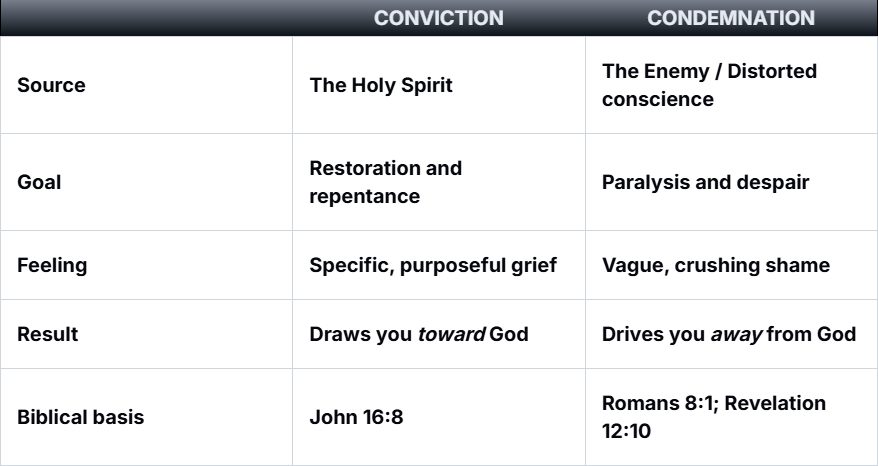
The Holy Spirit convicts you of a specific wrong so you can turn from it, confess it, and be restored. That discomfort has a direction—it points you toward the cross.
Condemnation, by contrast, is the voice that says “you’re beyond forgiveness,” “God is disgusted with you,” or “you’ve done this too many times.”
The Bible calls Satan “the accuser of our brothers and sisters” (Revelation 12:10). He doesn’t want you repentant. He wants you stuck.
A practical test: Does the guilt you feel lead you toward confession and change? That’s conviction working rightly. Does it lead to shame spirals, self-punishment, and spiritual paralysis? That’s condemnation—and you are not obligated to believe it.
Biblical Case Studies: People Who Failed and Were Restored
King David — The Portrait of Restoration
David committed adultery with Bathsheba and arranged the death of her husband, Uriah. These weren’t minor moral lapses. Yet Psalm 51—the great penitential psalm—is his response, and it remains one of the most honest prayers in all of Scripture:
“Create in me a clean heart, O God, and renew a right spirit within me.”
God didn’t discard David. He is still called “a man after God’s own heart.” This doesn’t minimize what David did. It demonstrates the scope of what repentance and atonement make possible.
The Apostle Peter — Failure at the Worst Moment
Peter denied knowing Jesus three times, on the night Jesus needed his closest friends most. He did it publicly. He did it after swearing he never would. And then, according to Luke 22:62, “he went out and wept bitterly.”
The risen Jesus didn’t appear to Peter with a list of grievances. He asked him three times—mirroring the three denials—”Do you love me?” and then restored him to ministry.
The structure of the restoration was shaped like the failure. Grace met Peter exactly where he had fallen.
The Prodigal Son — The Father Who Runs
In Luke 15, Jesus tells the story of a son who takes his inheritance early (an act culturally equivalent to wishing his father dead), wastes everything on reckless living, and returns home expecting to be made a servant. Instead, his father sees him from a distance, runs to him, and throws a party.
This is the definitive biblical image of how God responds to repentance. Not reluctant forgiveness. Running. Robes. A ring. A feast.
Self-Forgiveness in the Bible: Is It Real?
The phrase “forgive yourself” doesn’t appear in the Bible, which has led some to argue it’s a secular concept. But the principle it points to is thoroughly biblical.
In 2 Corinthians 7:10, Paul distinguishes between “godly grief” that leads to repentance and life, and “worldly grief” that leads to death. Prolonged self-punishment after a genuine confession is closer to worldly grief than godly grief.
It becomes, subtly, a way of paying for your own sin—as if Christ’s atonement wasn’t quite sufficient. The theological term is sanctification—the ongoing process of being conformed to Christ after justification. This process involves accepting grace not just for others but for yourself.
Refusing to do so isn’t humility. It can actually be a form of pride: insisting that your failure is uniquely too large for the cross to cover.

More Scripture on Guilt, Forgiveness, and Freedom
Understanding Guilt and Sin (The Diagnosis)
It’s natural to feel overwhelmed when you realize how far short you’ve fallen. The weight of guilt can feel crushing, especially when you understand that even one misstep separates us from God’s perfect standard. But recognizing our brokenness is actually the first step toward healing.
Scripture doesn’t minimize our sin—it diagnoses it honestly so we can receive the remedy God offers. Let these verses reveal both the seriousness of our condition and the hope that follows.
James 2:10 – For whoever keeps the whole law, and yet stumbles in one point, he has become guilty of all.
Leviticus 5:17 – “If anyone sins, doing any of the things which Yahweh has commanded not to be done, though he didn’t know it, he is still guilty, and shall bear his iniquity.
Romans 6:23 – For the wages of sin is death, but the free gift of God is eternal life in Christ Jesus our Lord.
God’s Complete Forgiveness (The Assurance)
Perhaps you’ve confessed your failures repeatedly, yet shame still whispers that you’re beyond redemption. The truth is profoundly different: God sent Jesus not to condemn you, but to rescue you completely. His forgiveness isn’t partial or conditional—it’s total and permanent.
When God forgives, He doesn’t just cover your sin; He removes it entirely, casting it into depths where it can never resurface. These verses offer the assurance your weary heart desperately needs.
John 3:17 – For God didn’t send his Son into the world to judge the world, but that the world should be saved through him.
Micah 7:19 – He will again have compassion on us. He will tread our iniquities under foot. You will cast all their sins into the depths of the sea.
Hebrews 8:12 – For I will be merciful to their unrighteousness. I will remember their sins and lawless deeds no more.”
Hebrews 9:14 – How much more will the blood of Christ, who through the eternal Spirit offered himself without defect to God, cleanse your conscience from dead works to serve the living God?
Your New Identity in Christ (The Identity)
Guilt often distorts how we see ourselves, leaving us feeling permanently stained and unworthy. Yet God sees you through an entirely different lens. In Christ, you’re not defined by your worst moments but clothed in His perfect righteousness. This isn’t just theological theory—it’s your actual standing before God right now.
The verse below reveals the breathtaking exchange that transforms your identity: His sinlessness for your guilt, His righteousness becoming yours.
2 Corinthians 5:21 – For him who knew no sin he made to be sin on our behalf, so that in him we might become the righteousness of God.
Responding to Guilt with Repentance (The Action)
Feeling convicted isn’t meant to trap you in endless regret—it’s God’s invitation to turn around and receive something better. Genuine repentance isn’t just feeling sorry; it’s choosing to walk in a new direction toward God’s grace.
When you respond to conviction with humble repentance, something remarkable happens: your sins are literally erased, and God’s refreshing presence floods in. This verse shows you the pathway from remorse to restoration.
Acts 3:19 – “Repent therefore, and turn again, that your sins may be blotted out, so that there may come times of refreshing from the presence of the Lord,
Finding Freedom and Grace (The Promise)
If guilt has kept you at arm’s length from God, afraid to approach Him with your needs, hear this liberating truth: you’re invited to come boldly. The accuser may relentlessly remind you of every failure, but he’s already been defeated.
God’s throne isn’t a place of harsh judgment for believers—it’s a throne of grace where mercy waits for you. These verses promise the freedom and help you’ve been longing for.

Hebrews 4:16 – Let’s therefore draw near with boldness to the throne of grace, that we may receive mercy and may find grace for help in time of need.
Revelation 12:10 – I heard a loud voice in heaven, saying, “Now the salvation, the power, and the Kingdom of our God, and the authority of his Christ has come; for the accuser of our brothers has been thrown down, who accuses them before our God day and night.
How to Bring Your Guilt to God: A Practical Process
These steps draw from the pattern of repentance seen throughout Scripture—from the Psalms to Paul’s letters.
- Name it specifically. Vague guilt is hard to release. God already knows; this is for your conscience. Psalm 51 is David naming exactly what he did.
- Confess it directly. 1 John 1:9 is a conditional promise: if we confess. Speak it, write it, or bring it before a trusted pastor or counselor.
- Receive the cross, not just the concept. The blood of Christ as atonement isn’t abstract. Something real was paid so that your guilt could be genuinely, legally removed.
- Turn from the behavior. Repentance means a change of direction. Confession without intention isn’t repentance—it’s rehearsal.
- Let the feelings come, then let them go. You may confess and still feel guilty. Don’t re-confess endlessly. Receive the grace, and when the feeling returns, remind your heart of what is already true.
- Find community. Guilt thrives in isolation. James 5:16 says confess to one another. There is something specific that happens when another human being, who knows you’ve failed, says, “You are forgiven.”
- Pursue ongoing renewal. Romans 12:2 speaks of the renewing of the mind. Guilt patterns can be deep grooves. Healing is often gradual, not sudden.
Does God Forgive Repeat Sins?
This question, asked honestly, often comes from a place of genuine exhaustion: “I’ve confessed this same sin so many times. Does it still count?”
Jesus was asked by Peter how many times forgiveness should be extended—seven times? Jesus answered seventy times seven (Matthew 18:21-22). This wasn’t a literal calculation. It was a way of saying the question itself misses the point. Forgiveness isn’t a quota system.
The danger of habitual sin is real—Paul addresses it frankly in Romans 6. Presuming on grace (sinning freely because forgiveness is guaranteed) is a different spiritual posture than genuinely repenting and genuinely struggling. God sees the difference, and so, in time, will you.
When Reading Isn’t Enough: Recognizing When to Seek Help
The Bible is not in competition with professional care. The body of Christ has always recognized the role of human instruments in the healing process—pastors, counselors, physicians, and communities.
If any of the following characterize your guilt, please consider reaching out to a professional:
- Intrusive, repetitive thoughts you cannot control despite sincere faith and confession.
- Inability to sleep, eat, or function normally.
- Thoughts of self-harm or that the world would be better without you.
- A pattern of confession and doubt that repeats relentlessly without relief
You can look for an ACBC Certified Biblical Counselor, a Licensed Christian Therapist or LMFT, or a Celebrate Recovery group in your area. Searching “Christian counseling near me” or “pastoral care [your city]” can surface local options.
Many churches offer free or reduced-cost pastoral counseling. Seeking this kind of help is not a failure of faith—it is wisdom.
Conclusion
Guilt is not the end of your story. The Bible’s overwhelming testimony—from the penitential psalms of David, to the restoration of Peter, to the theology of Romans 8—is that God’s grace is larger than your failure. Not barely larger. Vastly, completely, irreversibly larger.
There is a difference between the guilt that draws you back to God and the condemnation that chains you in place. One is the Spirit inviting you home. The other is a lie you are not obligated to believe.
If you have confessed—sincerely, specifically, with a heart that wants to change—then 1 John 1:9 is not a hope. It is a promise. You are forgiven. The east and the west will never meet. The scarlet is already white. Now let your heart catch up to what is already true.
Questions People Ask About Guilt and the Bible
Is feeling guilty a sin?
Not automatically. Guilt that comes from the Holy Spirit and leads to repentance is a healthy spiritual function. Guilt that becomes self-punishment or refuses the grace of God can become something that dishonors the work of the cross.
What is the difference between Holy Spirit conviction and Satan’s condemnation?
Conviction is specific, leads toward God, and produces change. Condemnation is vague, crushing, and pushes you away from God. The source makes all the difference—and so does the destination, the feeling points you toward.
Can God forgive the same sin over and over?
Yes. The question to honestly examine is whether you are genuinely repenting or presuming on grace. God’s mercy is infinite; the concern Scripture raises is not about His capacity to forgive but about our sincerity in asking.
What does the Bible say about forgiving yourself?
While the exact phrase isn’t in Scripture, prolonged self-condemnation after genuine confession can become a way of refusing God’s grace. Accepting forgiveness—fully, for yourself—is a form of faith.
What is scrupulosity, and is it addressed in the Bible?
Scrupulosity is religious OCD: relentless guilt cycles unresponsive to normal spiritual reassurance. While the Bible doesn’t use the term, passages like 1 John 3:20—”whenever our heart condemns us, God is greater than our heart”—speak directly to the overactive conscience. Professional support alongside pastoral care is strongly recommended.
What is the unforgivable sin?
The blasphemy of the Holy Spirit described in Mark 3:28-30 refers to willful, sustained attribution of the Spirit’s work to Satan—not to fleeting doubt or spiritual struggle. If you’re afraid you’ve committed it, that fear itself is evidence you likely haven’t.